Learning and Teaching

Learning and Teaching

Holistic Education Curriculum Guided by the National Curriculum
ZWIE | Systematic Solution that Meets the Demands of the Era
Systematic Solution that Meets the Demands of the Era

As the core vehicle of ZWIE's Integrated Eastern and Western Holistic Education, the Holistic Education Curriculum serves as both an active breakthrough in addressing the educational challenges of the AI era and a precise response to the demands of educational transformation.
The curriculum is centered on "holistic education" and "inquiry-based learning," deeply drawing on the IB's forward-thinking philosophy of breaking down subject barriers and focusing on comprehensive competencies, while appropriately incorporating the practical advantages of the DSE curriculum in subject application and academic progression. This forms the core logic of "tracing philosophical origins—grounding in local context," ultimately constructing a Sino-Western integrated curriculum framework that combines international perspectives with local foundations.
The Holistic Education Curriculum "integrates" the local foundation of the national curriculum standards, the holistic literacy concepts of IB education, the practical academic progression advantages of the DSE curriculum, and the wisdom essence of traditional Chinese culture, while also incorporating the requirements for core competency development in the AI era. It "innovates" by transcending the limitations of a single curriculum system, creating an innovative curriculum framework that balances competency cultivation and academic practice, rooted locally yet possessing an international vision capable of responding to technological changes. Furthermore, it represents a new educational paradigm that uses "integration" as the pathway and "holistic development" as the goal.
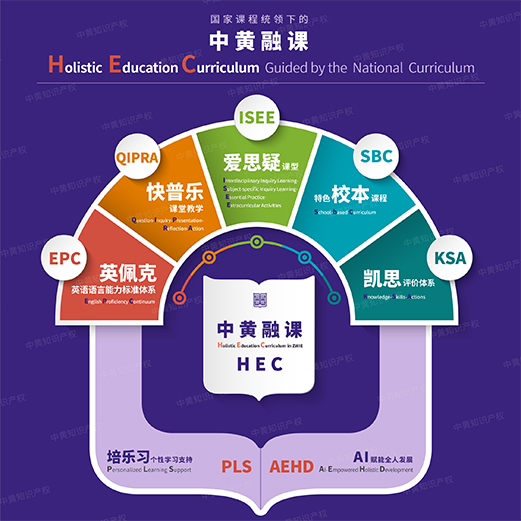
The Holistic Education Curriculum comprises five core domains and two supporting systems, not only forming a closed loop of "problem-solving—implementation assurance" but also demonstrating strong practicality, transferability, and referential value.
ZWIE | Systematic Solution that Meets the Demands of the Era
·HEC·
Holistic Education Curriculum Guided by the National Curriculum
ZWIE | The foundation of Chinese culture
The foundation of Chinese culture

In the context of globalization and multicultural integration, the inheritance and promotion of Chinese traditional culture hold great significance. The ZWIE Group regards the inheritance and development of Chinese culture as a core mission, and is committed to nurturing students' cultural awareness and confidence through its Traditional Chinese Culture Curriculum. It aims to shape lifelong learners, international communicators, and future creators with Junzi character and global competencies. The curriculum is founded on the five Confucian virtues: benevolence, righteousness, propriety, wisdom, and trustworthiness. It extracts three key competencies: correct values, essential character traits, and critical capabilities, which align with the competency-oriented goals of the new national curriculum. It covers five major themes: philosophy and thought, language and literature, traditional crafts and folklore, biological sciences in traditional Chinese medicine, and history and traditional festivals. This provides students with a comprehensive and in-depth cultural learning experience, ensuring a profound understanding of Chinese traditional culture.
Our curriculum system spans from preschool to high school, and breaks away from traditional models that prioritize activities over its meaning. It adopts Project-Based Learning (PBL), experiential, and inquiry-based teaching methods. The curriculum explores temporal and spatial dimensions using cross-cultural comparisons, and establishes an integrated system of teaching, learning, and assessment. The design takes into account students' age characteristics and cognitive levels, integrating contemporary cultural elements and cutting-edge research, to ensure content is relevant to students' lives while being forward-looking and contemporary. This structure enables students to grasp the essence of Chinese traditional culture and find their cultural identity in a multicultural context, fostering a global mindset and intercultural communication skills.The curriculum encourages innovation within the framework of tradition, empowering students to contribute to the modernization and global dissemination of Chinese culture, laying a solid cultural foundation for their holistic development.

ZWIE | The foundation of Chinese culture
·仁义礼智信·
Holistic Education Curriculum Guided by the National Curriculum
ZWIE | Interdisciplinary Inquiry, Subject -Specific Inquiry, Essential practice,ECA -ISEE
Interdisciplinary Inquiry, Subject -Specific Inquiry, Essential practice,ECA -ISEE

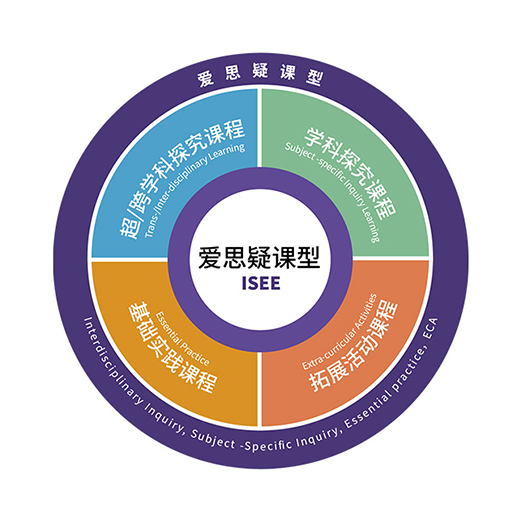
Within the framework of the national curriculum standards, ZWIE has innovatively constructed four types of courses: Interdisciplinary Inquiry Courses, Subject-Specific Inquiry Courses, Essential Practice Courses, and Extended Curriculum Activities (ECA). These courses not only implement national standards but also integrate advanced educational concepts, aligning with the core design of the IB Education PYP/MYP phases while accommodating the DSE curriculum's requirements for knowledge application and practical skills. By breaking down subject barriers, they help students apply knowledge comprehensively across different contexts, fostering critical thinking, cross-cultural perspectives, and practical abilities suited for academic progression.

ZWIE | Interdisciplinary Inquiry, Subject -Specific Inquiry, Essential practice,ECA -ISEE
·ECA·
Holistic Education Curriculum Guided by the National Curriculum
ZWIE | Question – Inquiry – Presentation – Reflection – Action-QIPRA
Question – Inquiry – Presentation – Reflection – Action-QIPRA

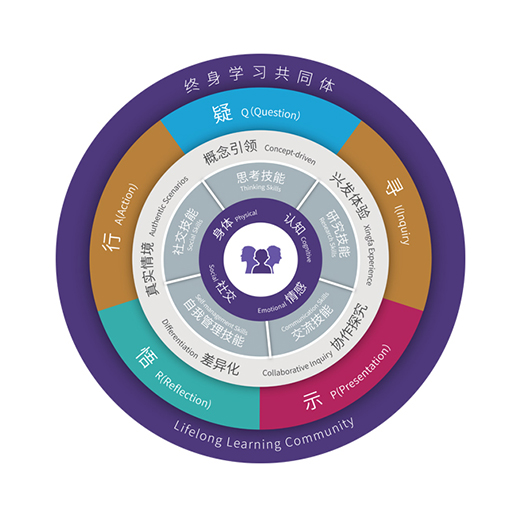
ZWIE adheres to the teaching philosophy of "learning begins with thinking, thinking originates from questioning" and has uniquely developed the QIPRA model. This model summarizes inquiry learning into five key steps: "Questioning, Inquiring, Presenting, Realizing, and Acting" . Through the processes of posing questions, exploring questions, resolving questions, reflecting on questions, and explaining questions, it completes the inquiry cycle.
The model clearly establishes students' central role as learners, shifting the traditional classroom from being "teaching-centered" to "learning-centered," and emphasizes teachers as "guides" rather than "knowledge imparters." Simultaneously, the classroom focuses on "knowledge application" and "practical inquiry," cultivating students' ability to solve real-world problems.
Compared to traditional classrooms, the QIPRA classroom places greater emphasis on student-led inquiry. This model deeply aligns with the national requirements for transforming educational approaches, stressing practical, inquiry-based learning, and integrates with innovative models such as Project-Based Learning (PBL) and situational teaching. Furthermore, its localized adaptation of the IB's advanced "inquiry cycle" concept, along with its consideration of DSE's practical application orientation, further enhances the classroom's efficiency in fostering students' core competencies and readiness for academic progression.

ZWIE | Question – Inquiry – Presentation – Reflection – Action-QIPRA
·QIPRA·
Holistic Education Curriculum Guided by the National Curriculum
ZWIE | School-Based Curriculum -SBC
School-Based Curriculum -SBC

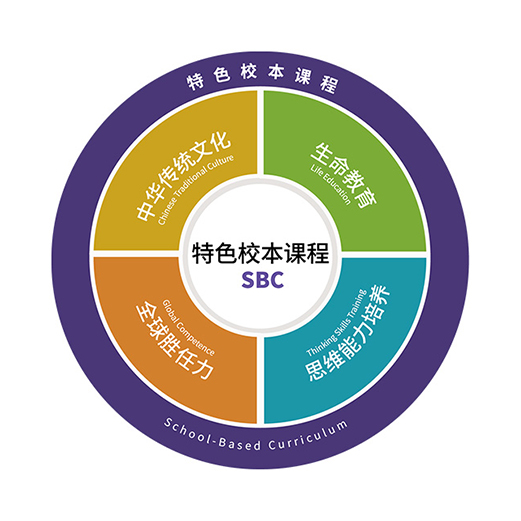
With "Integrated Eastern and Western Holistic Education" as the core educational philosophy, and drawing on over two decades of international education practice, ZWIE has deeply integrated both on-campus and off-campus resources (such as local traditional culture research institutions, martial arts and traditional medicine heritage bases, and educational cooperation platforms with Hong Kong and Macao) within the national curriculum framework. It has developed and implemented core modules including Traditional Chinese Culture, Life Education, Global Competence, and Consistent Thinking Skills Development, constructing a proprietary curriculum system that covers the entire educational span from preschool to high school. This system fully embodies ZWIE's school-based educational goal of "holistic education" throughout the entire learning journey.

ZWIE | School-Based Curriculum -SBC
·SBC·
Holistic Education Curriculum Guided by the National Curriculum
ZWIE | English Proficiency Continuum-EPC
English Proficiency Continuum-EPC

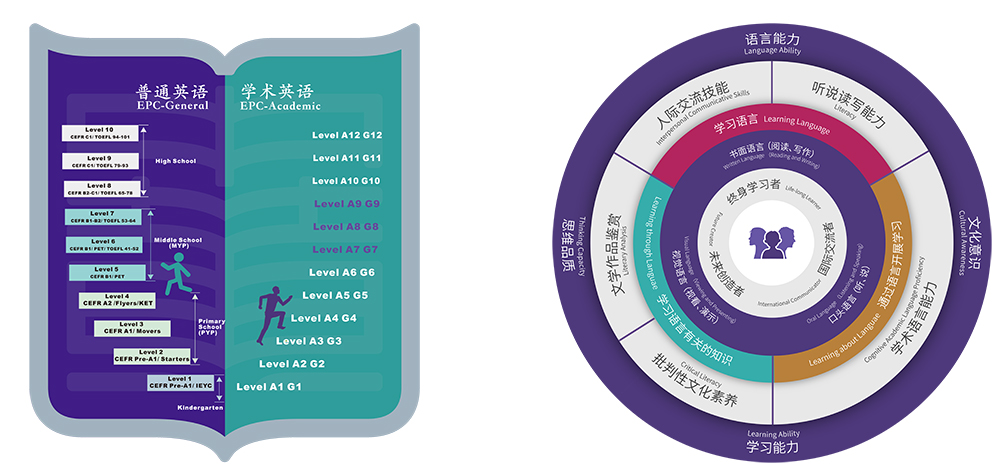
The English Proficiency Continuum (EPC) is an integrated core system for English teaching, assessment, and learning at ZWIE, encompassing three core values: it serves as an English proficiency standard covering all educational stages, a teaching diagnostic tool for evaluating instructional conditions, and a comprehensive platform supporting self-directed learning.
Built on a dual-track question bank system—EPC-G (General) for general English and EPC-A (Academic) for academic English (including subject-specific terminology, phrases, and expressions across different grades and stages)—the system is implemented through ZWIE's proprietary "Holistic Education Curriculum Connect" APP. This forms a complete closed loop of "standard-diagnosis-learning."

ZWIE | English Proficiency Continuum-EPC
·EPC·
Holistic Education Curriculum Guided by the National Curriculum
ZWIE | Knowledge-Skills-Actions-KSA
Knowledge-Skills-Actions-KSA

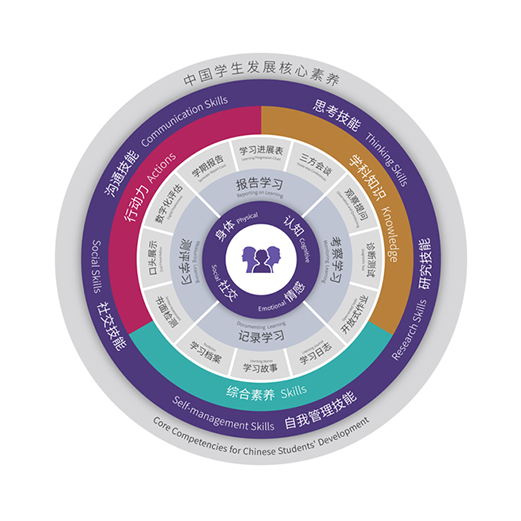
Rooted in the core competencies for Chinese student development, the KSA (Knowledge-Skills-Actions) evaluation system is structured across four dimensions: cognitive, emotional, social, and physical. "KSA" is a homophone in Chinese, representing the three core elements: Knowledge, Skill, and Action.
The KSA evaluation system specifically covers three core areas: subject knowledge, comprehensive literacy, and action competence. It adheres to a dual-track assessment of "academic quality + comprehensive literacy," implemented through four differentiated evaluation methods, forming a replicable practical model.
This system not only centers on the "Five Education Domains" (moral, intellectual, physical, aesthetic, and labor education) as its core orientation, providing comprehensive support for students' holistic development and personalized growth, but also achieves breakthrough innovation in educational evaluation. It breaks the limitations of "score-only emphasis" by deeply integrating academic quality and comprehensive literacy assessment. Simultaneously, it closely aligns with the new college entrance examination reform, incorporating evaluation results of "comprehensive literacy" and "action competence" into comprehensive quality profiles, offering more multidimensional growth evidence. This fully aligns with the current direction of educational evaluation reform.

ZWIE | Knowledge-Skills-Actions-KSA
·KSA·
Holistic Education Curriculum Guided by the National Curriculum
ZWIE | Personalized Learning Support -PLS
Personalized Learning Support -PLS

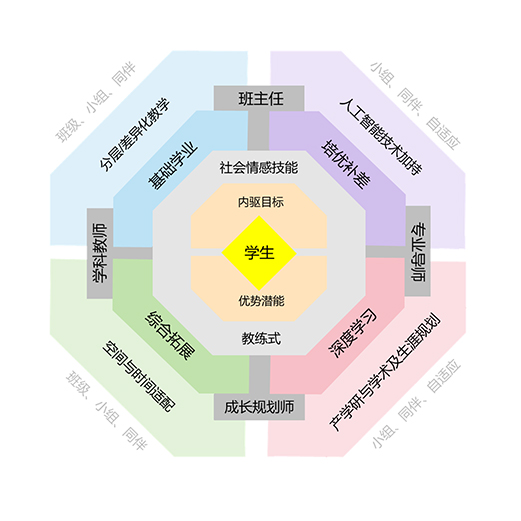
ZWIE consistently upholds the philosophy that "every student is unique and has the potential to succeed," committed to building a personalized support system that covers all ages, all settings, and the entire process both inside and outside the school.
The Personalized Learning Support (PLS) system relies on scientific data analysis and learning theories, focusing on students' interests, abilities, learning styles, and developmental needs to implement personalized cultivation based on holistic assessment. This forms a growth planning system characterized by "one student, one plan, one specialty; one student, one strategy." This model directly implements the IB education strategy of "personalized learning"—IB education emphasizes "respecting individual differences among students" and provides tailored learning resources and guidance through the "Learning Support Plan" for students with different learning styles and ability levels, avoiding the limitations of "standardized teaching" on student potential. Simultaneously, the targeted cultivation of "subject competence and practical application" in personalized planning also helps students better adapt to the requirements of DSE assessments.

ZWIE | Personalized Learning Support -PLS
·PLS·
Holistic Education Curriculum Guided by the National Curriculum
ZWIE | AI- empowered Holistic Education-AEHD
AI- empowered Holistic Education-AEHD

In the era of deep integration between artificial intelligence (AIGC) and education, ZWIE has adopted AI-empowered "adaptive learning" as its core goal, constructing an intelligent education support system that covers the entire process of "teaching, learning, and assessment." Through the AI-integrated Holistic Education Curriculum Connect learning system, it dynamically analyzes student learning data, accurately identifies knowledge weaknesses and differences in learning styles, and pushes personalized content and resources in real time.
Simultaneously, AI efficiently handles fundamental teaching tasks such as lesson plan generation, homework grading, feedback optimization, and classroom management, allowing teachers to transition from "transactional roles" back to "guides and motivators." This enables educators to devote more energy to learning analytics, personalized tutoring, and classroom interaction design, achieving a dual leap in both teaching effectiveness and learning experience.
Building on this, ZWIE is concurrently advancing the strategic deployment of a digital human platform, creating an innovative application ecosystem that integrates intelligence, visualization, and engagement. This effort will deepen AI empowerment across three core scenarios: campus digital spokespersons, teaching assistants for educators, and student "learning companion" systems.

ZWIE | AI- empowered Holistic Education-AEHD
·AEHD·
Holistic Education Curriculum Guided by the National Curriculum
ZWIE | 中黄学习社区
中黄学习社区
Learning Community

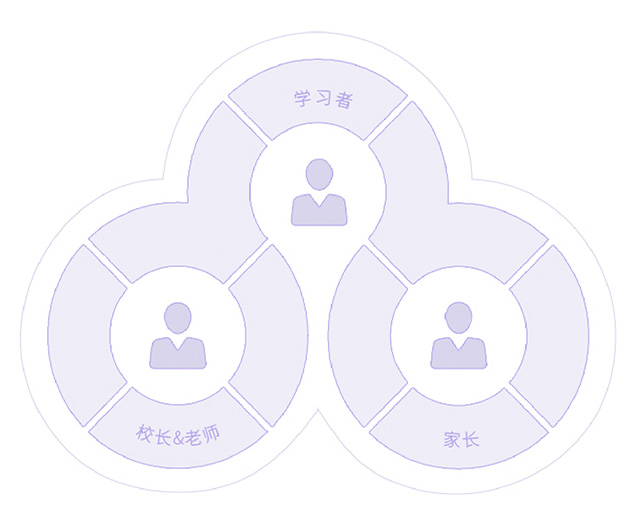
积极探索家庭、学校、社会协同育人新模式,构建学习共同体。
校长、教师作为促进者与组织者、国内外社区资源整合者,激发学习者的内驱力;
家长作为学校管理的参与者、教学资源的支持者,支持有内驱力的学习者;
该学习社区构建了学校主导、家庭参与、社会支持的育人网络,规范校外培训,强化实践育人,符合家校社会协同育人的要求。

校长&教师
促进者与组织者
国内外杜区资源整合者
学习者
激发学习者的内驱力
家长
学校管理的参与者
教学资源的支持者
支持有内驱力的学习者
ZWIE | 中黄学习社区
·LC·
Diversified Chinese-Western Integration Programme

International Baccalaureate

ZWIE | International Baccalaureate
The International Baccalaureate (IB) education is an integrated international education system designed by the International Baccalaureate Organization (IBO) for children and adolescents aged 3-19. Known for its comprehensive educational goals, balanced cultivation model, and rigorous evaluation system, IB is regarded as the most recognized holistic education model worldwide.
ZWIE offers students a continuous fifteen-year IB holistic education.
In implementing IB education, ZWIE aligns with the mid-to-long-term strategic goals of initially becoming a strong educational nation by 2027 and achieving educational modernization by 2035. This involves systematically advancing deep reforms in educational methods and school-running models to closely match the direction and goals of international educational development.
ZWIE | International Baccalaureate

Hong Kong Diploma of Secondary Education Programme(Grade 10-Grade 12)

ZWIE | Hong Kong Diploma of Secondary Education Programme(Grade 10-Grade 12)
The Hong Kong Diploma of Secondary Education Examination (HKDSE) is a public examination launched by the Hong Kong government, equivalent to the university entrance examination in Hong Kong. It is the only international exam that can be answered in Chinese (excluding English subjects). The results of the HKDSE are recognized by over 300 universities in Hong Kong, Macao, Taiwan, and overseas (including prestigious universities like the University of Hong Kong, University of Cambridge, National University of Singapore, Australian National University, and others) and more than 130 key universities in mainland China (including well-known institutions such as Tsinghua University, Peking University, and Fudan University).
The two ZWIE schools for Hong Kong and Macao students implement a forward-looking DSE curriculum empowered by IB, employing IB learning and teaching methods in the execution of the DSE curriculum. They use IB's ten learner profile goals to develop students' core competencies and the QIPRA teaching methodology to better stimulate students' intrinsic motivation. This approach helps cultivate lifelong beneficial skills in thinking, research, communication, social interaction, and self-management, comprehensively supporting students' balanced development in both academic and personal fields.
ZWIE | Hong Kong Diploma of Secondary Education Programme(Grade 10-Grade 12)

ANMERICAN HIGH SCHOOL CURRICULUM

ZWIE | ANMERICAN HIGH SCHOOL CURRICULUM
Since 2018, ZWIE has collaborated closely with Griggs International Academy (GIA) to develop the American high school curriculum project, known as ZWIE World Academy (ZWA). GIA rigorously approves and reviews all educational elements, including teacher qualifications, course materials, and examinations, to ensure that students receive a fully accredited American high school diploma. The GIA American high school curriculum is widely applied worldwide, educating millions of students across more than 3,000 schools in 115 countries. It is certified by seven major authoritative organizations and is recognized globally as a trusted education service provider. Due to its superior educational quality and course offerings, ZWA is ranked among the top 100 international schools in China, with its American high school program achieving the second-highest rating in the South China region. After integrating the ZWA project team and expertise into the schools for Hong Kong and Macao students, ZWIE continues to adhere to its educational philosophy of integrating Eastern and Western methodologies. Drawing on the mature experience from the ZWA project, the school continues to offer high-quality American high school courses for students in grades 9-12.
ZWIE | ANMERICAN HIGH SCHOOL CURRICULUM

ZWIS x AIXY INNOVATION SCHOOL

ZWIE | ZWIS x AIXY INNOVATION SCHOOL
ZWIS x AIXY INNOVATION SCHOOL offers art and design innovation programmes for students with design interests, and provides artoriented international education services for students in grades 9 to 12. The college has set up six laboratories, including Pure Art and Regional Culture Laboratory, Entertainment and lustration Design Laboratory, industrial and Furniture Design Laboratory, Interactive and Graphic Design Laboratory, Fashion and Business Application Laboratory, and Architecture and Social Practice Laboratory.
ZWIE | ZWIS x AIXY INNOVATION SCHOOL
01/ 05